
Ventral / Incisional / Umbilical Hernia
What Is a Ventral Hernia?

A ventral hernia occurs when soft tissue, usually part of the intestine or fatty tissue, pushes through a weakness in the muscles of the abdominal wall anywhere except the groin. This creates a bulge that may be visible or felt under the skin particularly when standing, straining or coughing
What Is an Incisional Hernia?
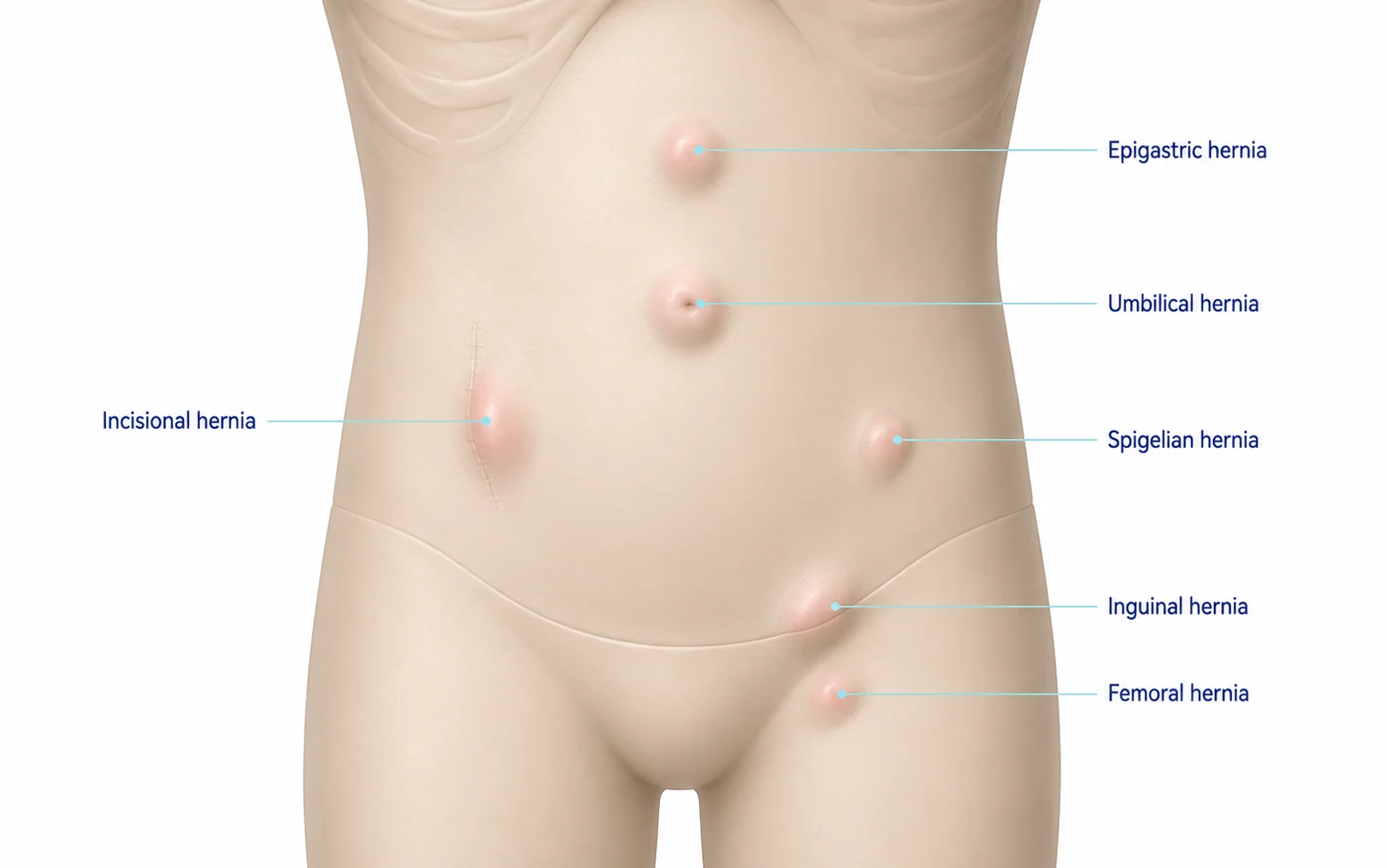
An incisional hernia is a specific type of ventral hernia that develops at the site of a previous surgical incision, where the abdominal wall has been weakened by the earlier surgery. These can occur months or even years after the original operation and are one of the more common long-term complications of abdominal surgery
Types of Ventral Hernia
- Incisional hernia: occurs at the site of a prior surgical incision
- Umbilical hernia: occurs at or near the belly button
- Epigastric hernia: occurs in the upper abdomen, between the breastbone and belly button
- Spigelian hernia: a less common type occurring along the outer edge of the abdominal muscle
Symptoms
- A bulge in the abdomen which may appear or become more noticeable when standing, coughing or straining
- Associated with dull ache, heaviness, dragging sensation or burning in the groin
- Can increase in size over time
- May have no symptoms and can be found incidentally during an exam
Causes and Risk Factors
Ventral hernias develop when a weakness in the abdominal wall combines with increased pressure in the abdomen
Common contributing factors include:
- Previous abdominal surgery especially if the wound was slow to heal or became infected
- Obesity
- Pregnancy
- Chronic cough from smoking or lung disease
- Chronic constipation or straining during bowel movements
- Heavy lifting or straining
- Poor wound healing due to diabetes, smoking or certain medications such as steroids
- Older age
- A naturally occurring weak spot in the abdominal wall, present from birth as seen in umbilical hernias
Diagnosis
Ventral and incisional hernias are usually diagnosed through a physical examination, checking for a bulge that becomes more prominent while standing or straining
Imaging such as an ultrasound or CT scan may be used to confirm the diagnosis, measure the size of the defect and assess the abdominal wall in more detail. This is particularly useful for larger or more complex incisional hernias or when planning surgical repair
Treatment Options
Surgery is the only way to permanently repair a ventral or incisional hernia
Watchful waiting
Small hernias causing few or no symptoms may be monitored rather than repaired immediately particularly in patients with significant surgical risk. Larger hernias or those causing ongoing symptoms are generally repaired to prevent complications and further enlargement
Surgical repair
The approach depends on the size, location and complexity of the hernia
- Open repair: an incision is made over the hernia and the defect is closed, typically reinforced with surgical mesh for larger defects.
- Laparoscopic (keyhole) repair: performed through a few small incisions using a camera and specialised instruments, often allowing a faster recovery and less post-operative pain for suitable hernias
- Component separation or complex reconstruction: for large or recurrent incisional hernias, more advanced techniques may be needed to rebuild the abdominal wall, sometimes involving a longer recovery period
The most suitable technique will depend on the size and location of the hernia, the condition of the abdominal wall, the person's overall health and whether they've had previous repairs
Recovery After Surgery
- Recovery time varies depending on the size and complexity of the repair
- Some people go home the same day or after 1-3 nights in hospital, depending on the extent of surgery
- Mild to moderate discomfort is common for 1-2 weeks after a straightforward repair
- Larger reconstructions may take longer
- Light activity can usually resume within a few days
- Heavy lifting and strenuous exercise should be avoided for 6-8 weeks
- Most people return to desk-based work within 1-2 weeks and physical jobs after 4-6 weeks
- Complex repairs may require a longer recovery
Risks and Complications
As with any surgery, ventral and incisional hernia repair carries some risk including:
- Infection
- Bleeding
- Recurrence of the hernia
- Seroma (fluid collection) at the surgical site
- Chronic pain or numbness
- Injury to nearby structures such as the bowel
- Reaction to surgical mesh in rare cases
When to Seek Urgent Medical Care
A ventral or incisional hernia can become a medical emergency if the protruding tissue becomes trapped (incarcerated) or loses its blood supply (strangulated). Seek immediate medical attention if you experience:
- Sudden severe pain at the hernia site
- A bulge that becomes hard, tender or cannot be pushed back in
- Nausea, vomiting or fever alongside hernia symptoms
- Redness or discoloration of the skin over the hernia
This is considered a medical emergency and requires prompt evaluation